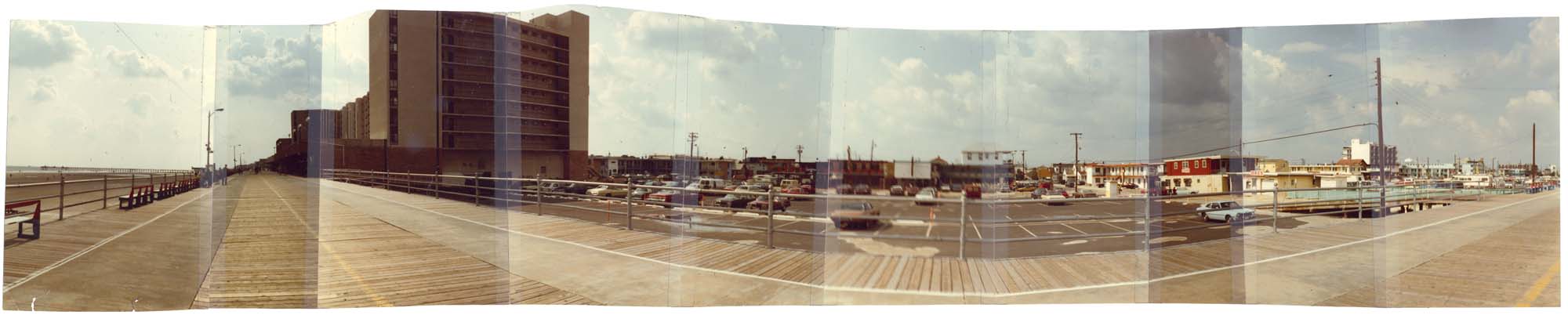
Albert Moser lived with his parents, Russian Jewish immigrants, until the age of 60. In his youth, after being sent to Japan with the American occupation forces, he held a variety of odd jobs: aircraft washer on a military base, candy seller… Yet he always dreamed of becoming a photographer. He notably attended photography classes at the School of Industrial Arts as part of the training programs offered to former GIs. Following this experience, he had a stamp made bearing the word “photographer,” which he used on the backs of his photographs alongside a meticulous description of his shots.
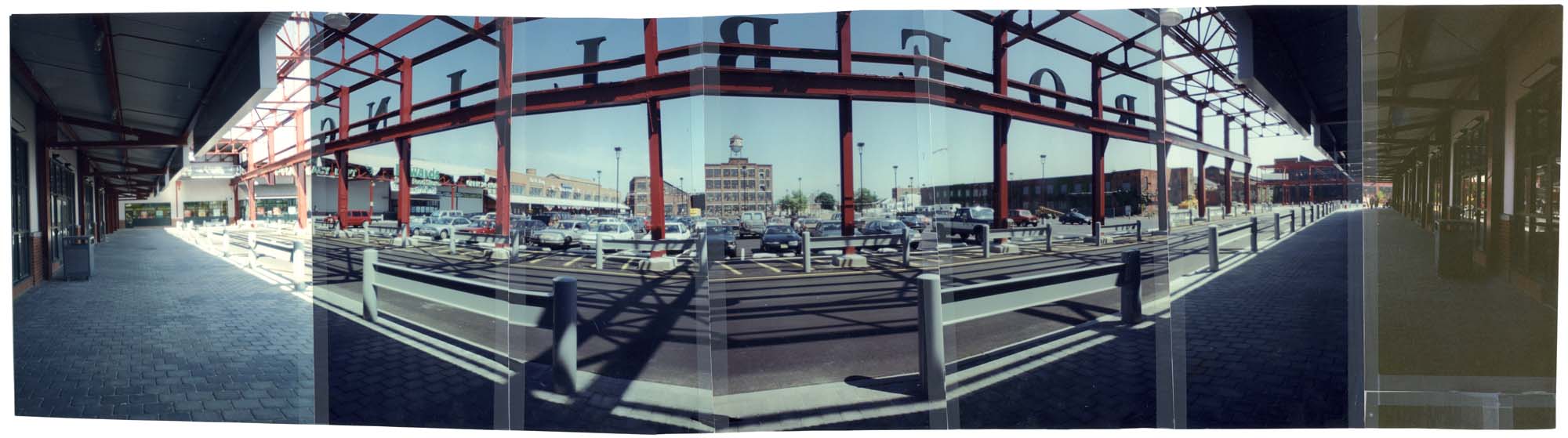
From the 1970s onward, and for more than 25 years, he produced several hundred panoramic photographs, some extending to 360°. Printed in amateur formats — often 10 × 15 cm — by a local photographer, these images were then carefully reassembled into linear urban landscapes, pieced together photograph by photograph. Using scissors, he meticulously aligned the joins and connected the fragments with transparent tape or “masking tape,” giving his compositions a singular material presence and a distinctive plastic quality.
These works reveal a desire to reinvent, even distort, the reality captured by the lens. The landscape folds back on itself, creating an optical vertigo that contrasts with the expansive nature of the panorama. Albert Moser, however, never sought to exhibit his work: he kept his compositions rolled up one inside another, at the bottom of a bag, hidden from view, until their fortuitous discovery.
By country
- Angola
- Argentina
- Austria
- Belgium
- Benin
- Brazil
- Canada
- Chile
- Colombia
- Croatia
- Cuba
- Czech Republic
- Finland
- France
- Germany
- Guatemala
- Haiti
- India
- Iran, Islamic Republic of
- Italy
- Jamaica
- Japan
- Korea, Republic of
- Mexico
- Morocco
- Namibia
- Netherlands
- Papua New Guinea
- Peru
- Philippines
- Poland
- Portugal
- Russian Federation
- Senegal
- Serbia
- Slovakia
- Spain
- Sweden
- Switzerland
- United Kingdom
- United States
- Uruguay
collection | general collection | M | MOSER Albert
MOSER Albert
1/3