
Henry Darger was four years old when his mother died in childbirth, giving birth to a sister who was immediately placed with a foster family. At age eight, Darger was sent to a children’s home and then institutionalized in a facility for children with developmental delays, from which he escaped at 17. In the early 1920s, he was employed as a janitor in a Chicago hospital, where he remained until his retirement in 1963.
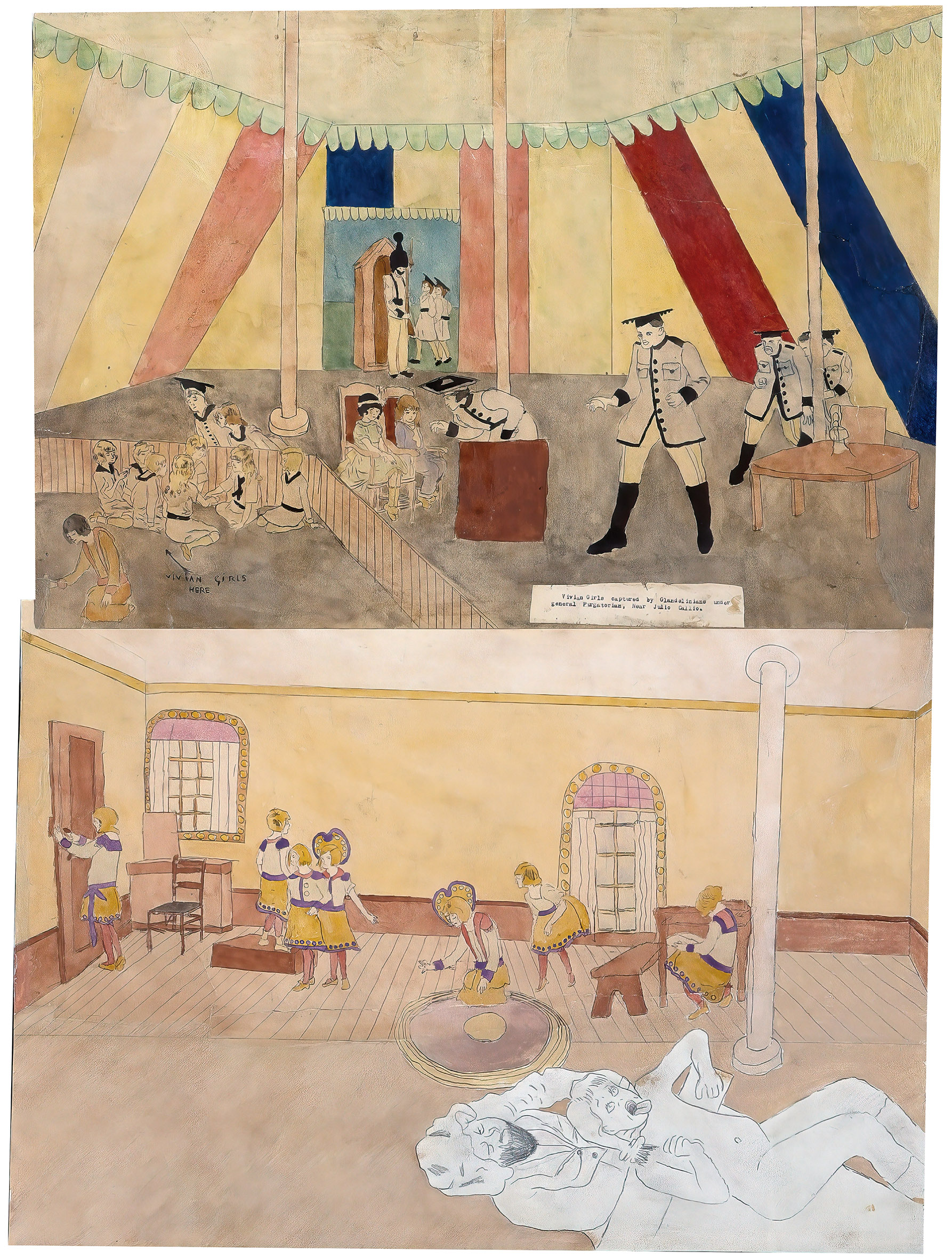
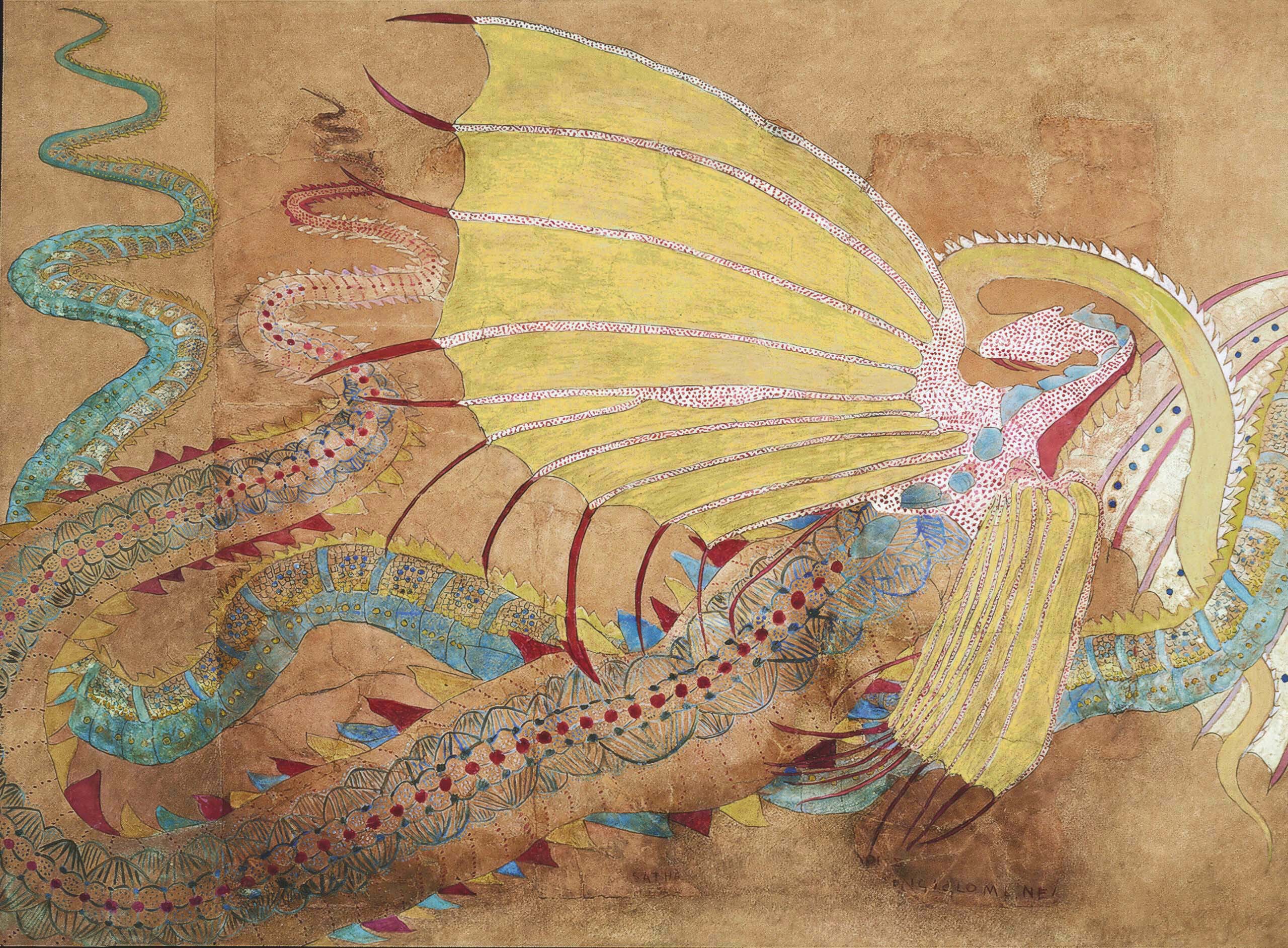
Nothing in this quiet life suggested what Nathan Lerner, the owner of the room Darger rented, would discover after Darger moved to a retirement home in 1972: a fifteen-thousand-page saga in fifteen volumes, richly illustrated, titled In the Realms of the Unreal. This monumental work, begun between 1910 and 1912, was created in complete secrecy. The narrative recounts the struggle of the young Vivian sisters against the adult population of the Glandelinians, who enslave, torture, and murder children. The text
was later accompanied by large, double-sided watercolor panoramas and various collages.
From 1946 onward, Darger used photographic enlargements and tracings, enabling him to reproduce images multiple times and create what amounted to “armies” of cloned children. When asked every Sunday after church by Kiyoko Lerner how he was doing, he would reply, “Tomorrow, perhaps, the wind will stop blowing.” The first exhibition of this extraordinary work was organized by Lerner, himself an artist, at the Hyde Park Art Center in Chicago in 1977.
By country
- Angola
- Argentina
- Austria
- Belgium
- Benin
- Brazil
- Canada
- Chile
- Colombia
- Croatia
- Cuba
- Czech Republic
- Finland
- France
- Germany
- Guatemala
- Haiti
- India
- Iran, Islamic Republic of
- Italy
- Jamaica
- Japan
- Korea, Republic of
- Mexico
- Morocco
- Namibia
- Netherlands
- Papua New Guinea
- Peru
- Philippines
- Poland
- Portugal
- Russian Federation
- Senegal
- Serbia
- Slovakia
- Spain
- Sweden
- Switzerland
- United Kingdom
- United States
- Uruguay
collection | general collection | D | DARGER Henry
DARGER Henry
1/3
![DARGER Henry. Plain [...] Back knowing the way out saves them (At the second battle of Marocino...) (recto) / At Jennie Richie – and force him to make them pass through the enemy lines... (verso). Collages, gouache, mine de plomb et encre sur papier. 48 x 241,5 cm](https://abcd-artbrut.net/wp-content/uploads/2026/03/DARGER-Henry-1-B-scaled.jpg)