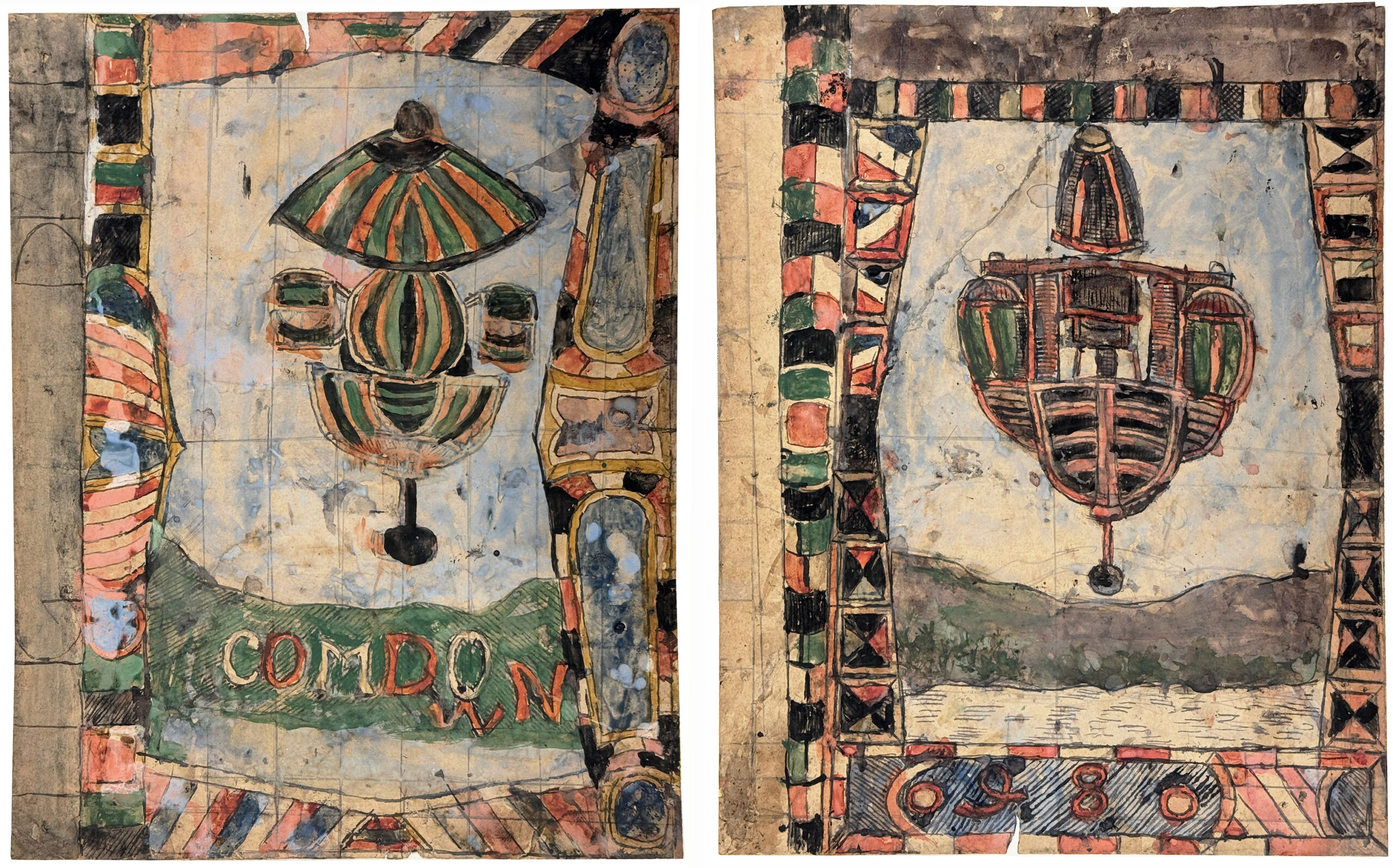
Charles Dellschau emigrated to Texas in the 1850s. He is also believed to have lived in California, where he reportedly worked as a draftsman for a secret society, the Sonora Aero Club, one of the earliest aeronautical societies in the United States. This club brought together inventors of flying machines some fifty years before the Wright brothers’ first flight.
During the Civil War, Dellschau married a young widow, with whom he had three children. While little is known about his earlier activities, records indicate that he worked as a butcher in Fort Bend County near Houston. In 1877, he lost his wife and his very young son. He later worked for a period at a horse-saddle manufacturer.
In retirement, Dellschau secretly created twelve manuscripts composed of collages, writings, and drawings of aircraft—the inventions, he claimed, of his colleagues in the Sonora Aero Club. From 1914 onward, his collages and vibrant, circus-poster-style drawings, reminiscent of Barnum, became darker and more serious, often depicting contemporary catastrophes. These notebooks resurfaced in the late 1960s through an antique dealer; they had been left by the wayside after a fire. Pages from three of the notebooks were scattered, while the remaining nine, intact, are preserved in museums, including one at the Centre Pompidou. Judging by the number of pages produced, Dellschau painted roughly one flying machine per day from his retirement until his death in 1923.
By country
- Angola
- Argentina
- Austria
- Belgium
- Benin
- Brazil
- Canada
- Chile
- Colombia
- Croatia
- Cuba
- Czech Republic
- Finland
- France
- Germany
- Guatemala
- Haiti
- India
- Iran, Islamic Republic of
- Italy
- Jamaica
- Japan
- Korea, Republic of
- Mexico
- Morocco
- Namibia
- Netherlands
- Papua New Guinea
- Peru
- Philippines
- Poland
- Portugal
- Russian Federation
- Senegal
- Serbia
- Slovakia
- Spain
- Sweden
- Switzerland
- United Kingdom
- United States
- Uruguay
collection | general collection | D | DELLSCHAU Charles August Albert
DELLSCHAU Charles August Albert