Abandoned by his alcoholic father at the age of seven, Adolf Wölfli was placed as a farm servant and shuffled between families.
At ten, he suffered the devastating loss of his beloved mother. As an adult, he was repeatedly arrested for indecent acts and ultimately institutionalized at Waldau Psychiatric Hospital, where he remained for the rest of his life.
During his first five years in the hospital, his mental state deteriorated, and he experienced frequent hallucinations. Around 1900, Wölfli began to draw, write, and compose music. In 1907, Dr. Walter Morgenthaler, assigned to the hospital, recognized the singular quality of his work and later devoted a monograph to him in 1921, acknowledging him as a true artist.
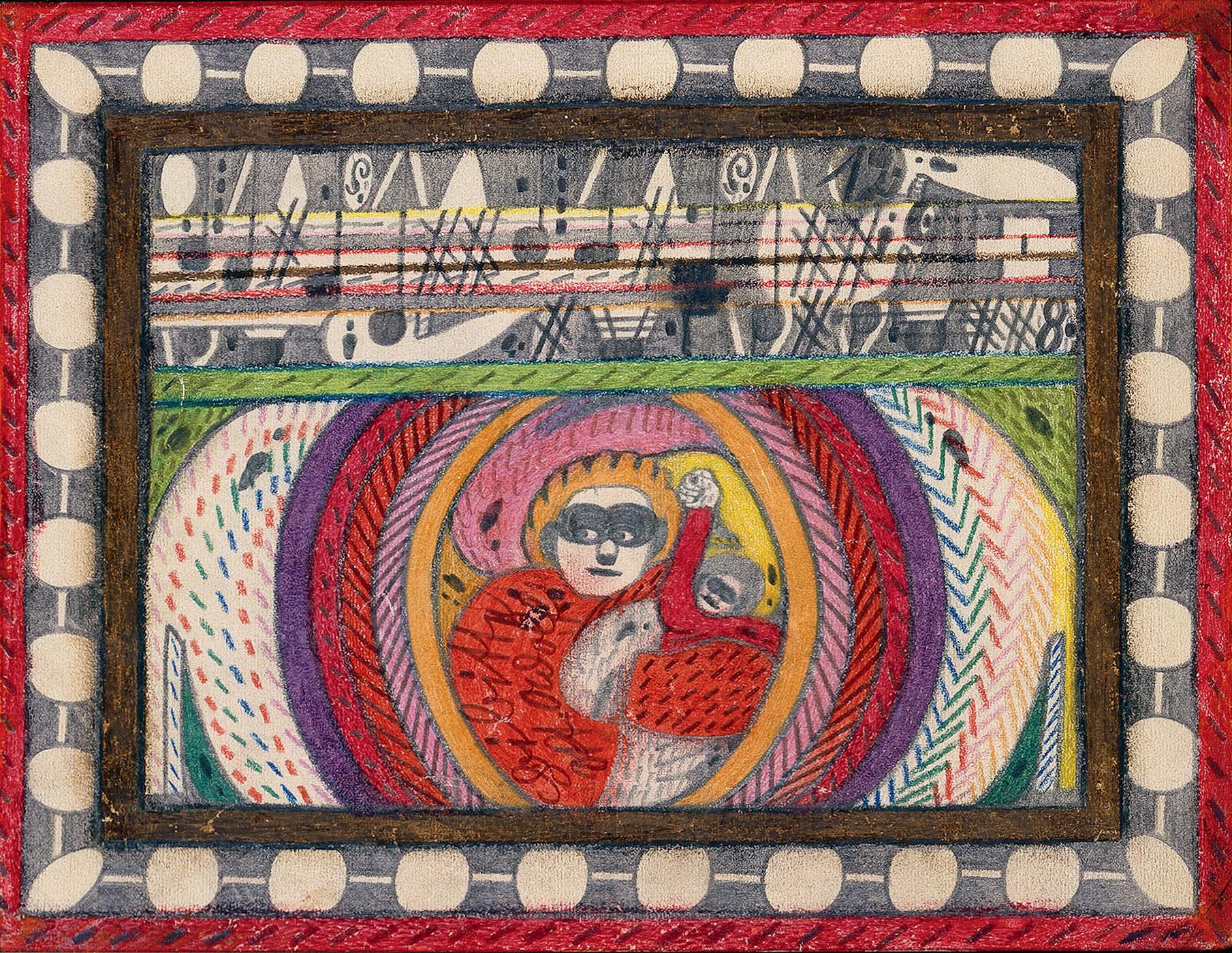
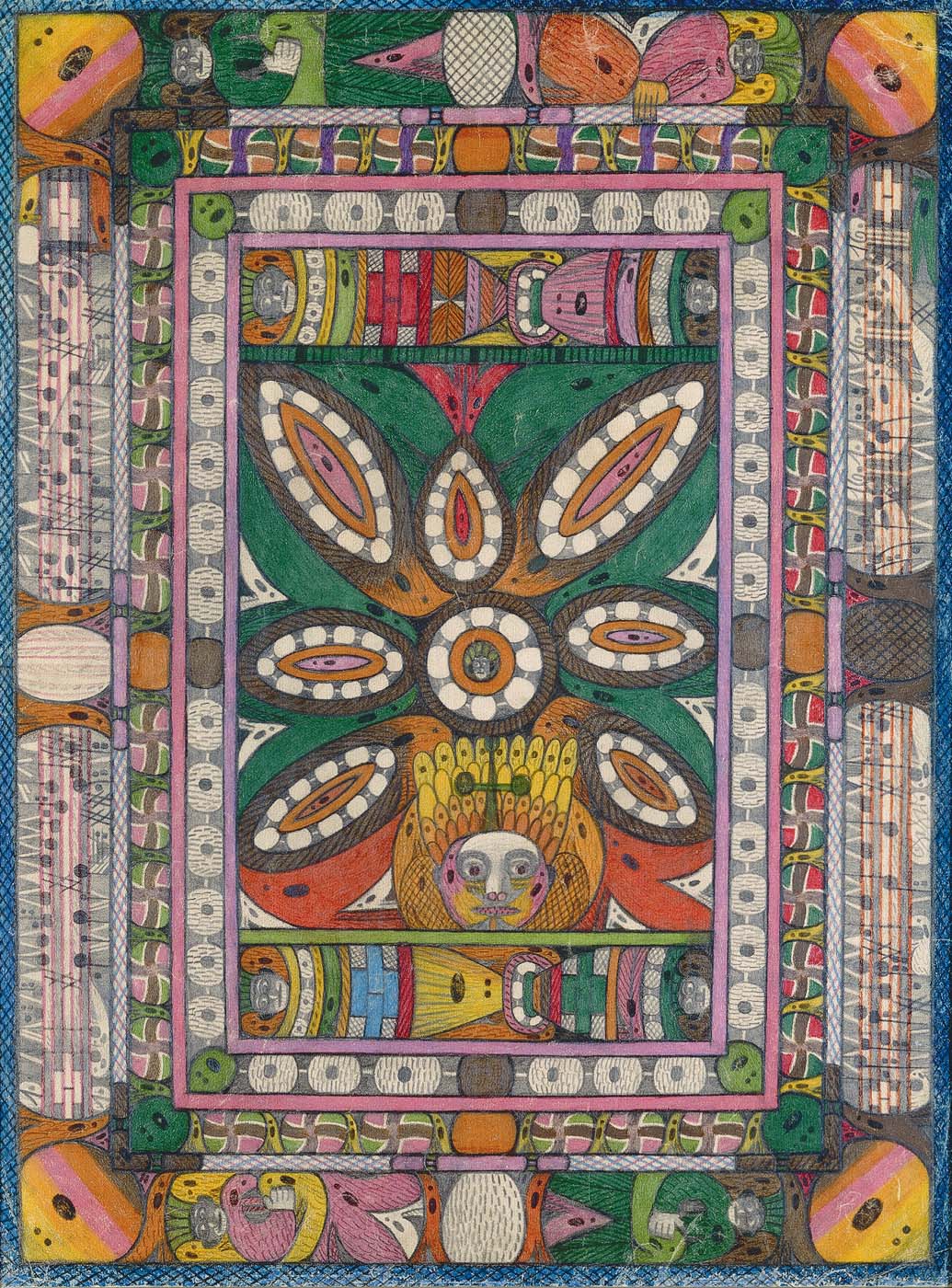
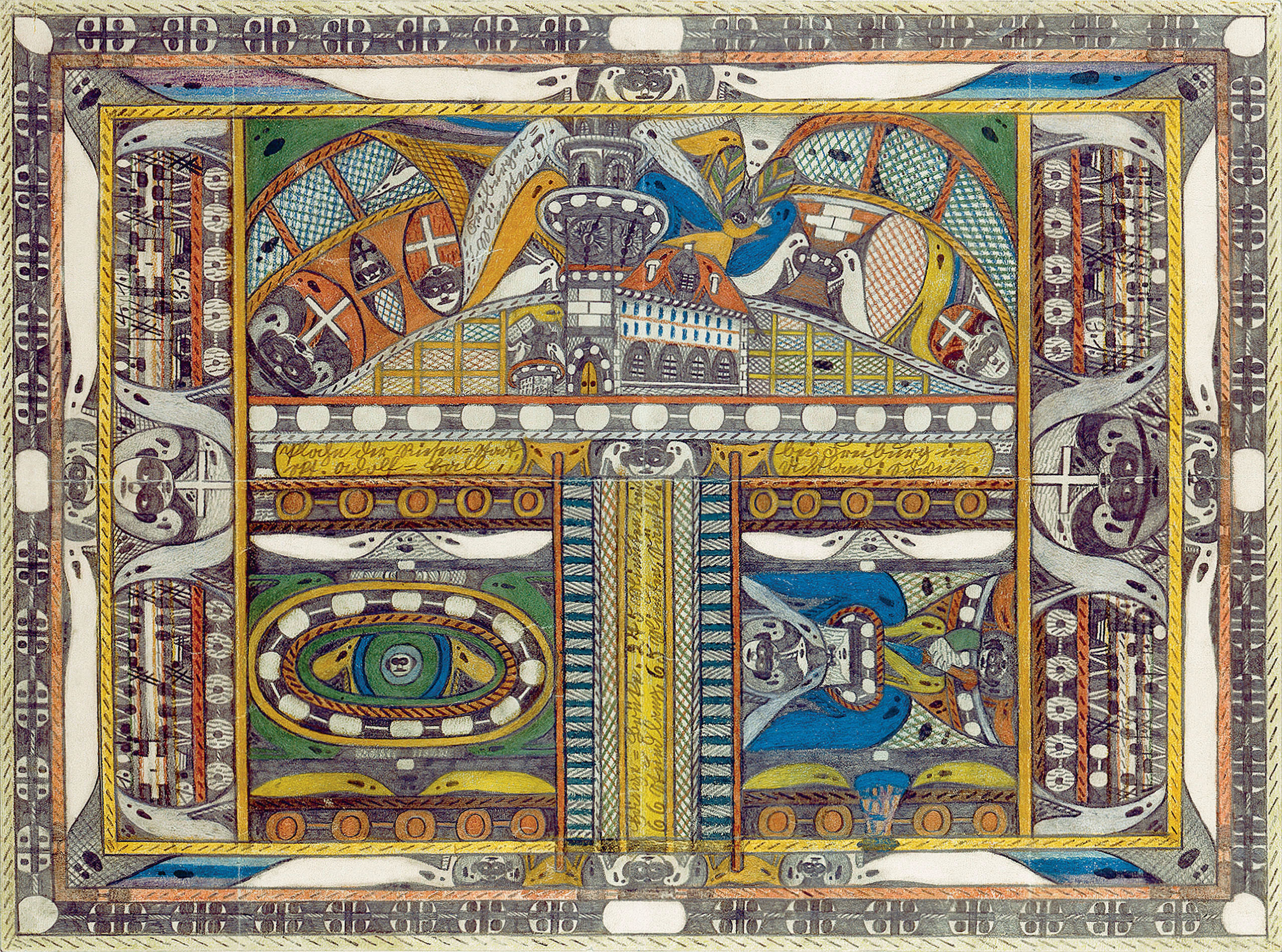
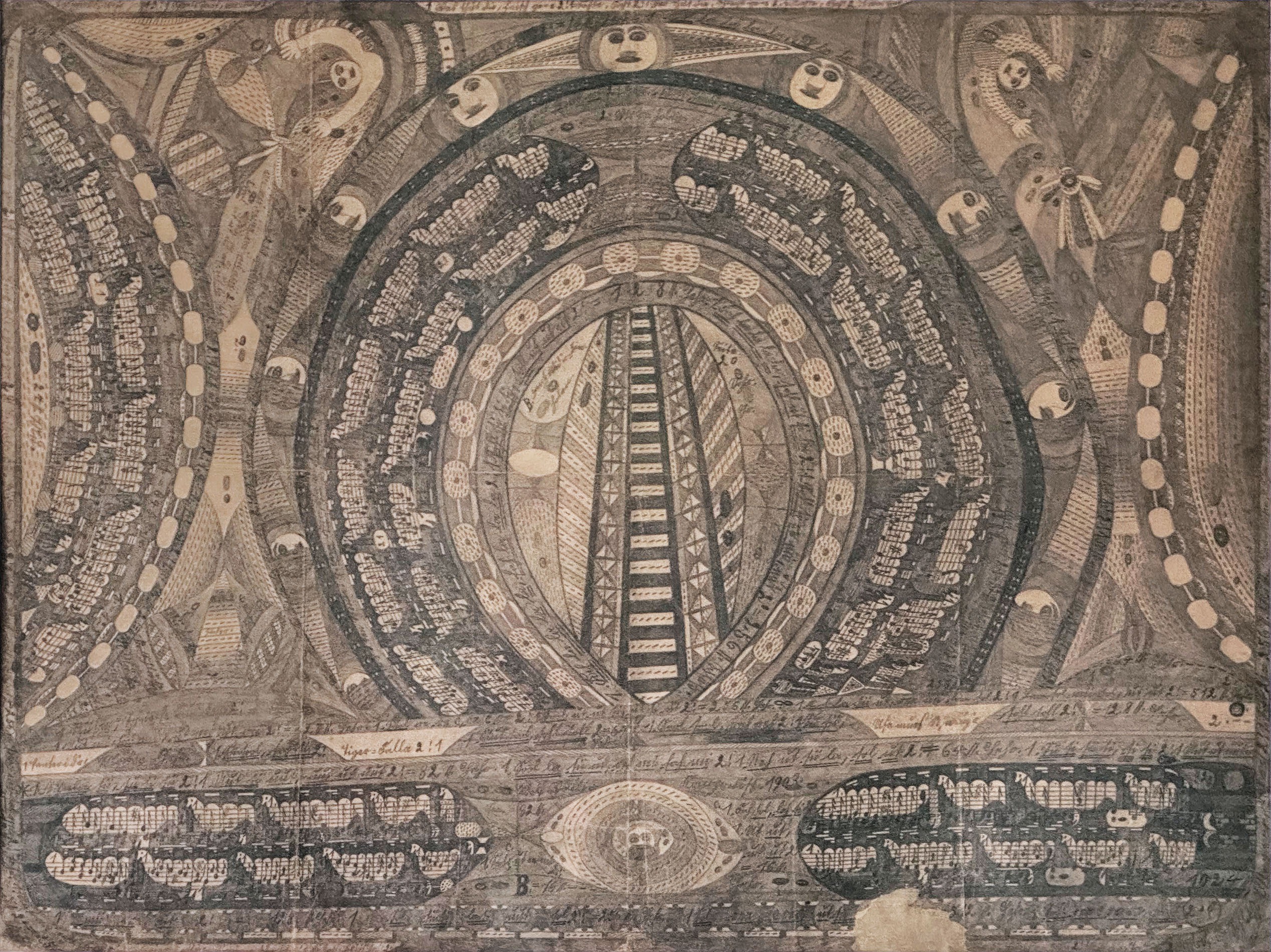
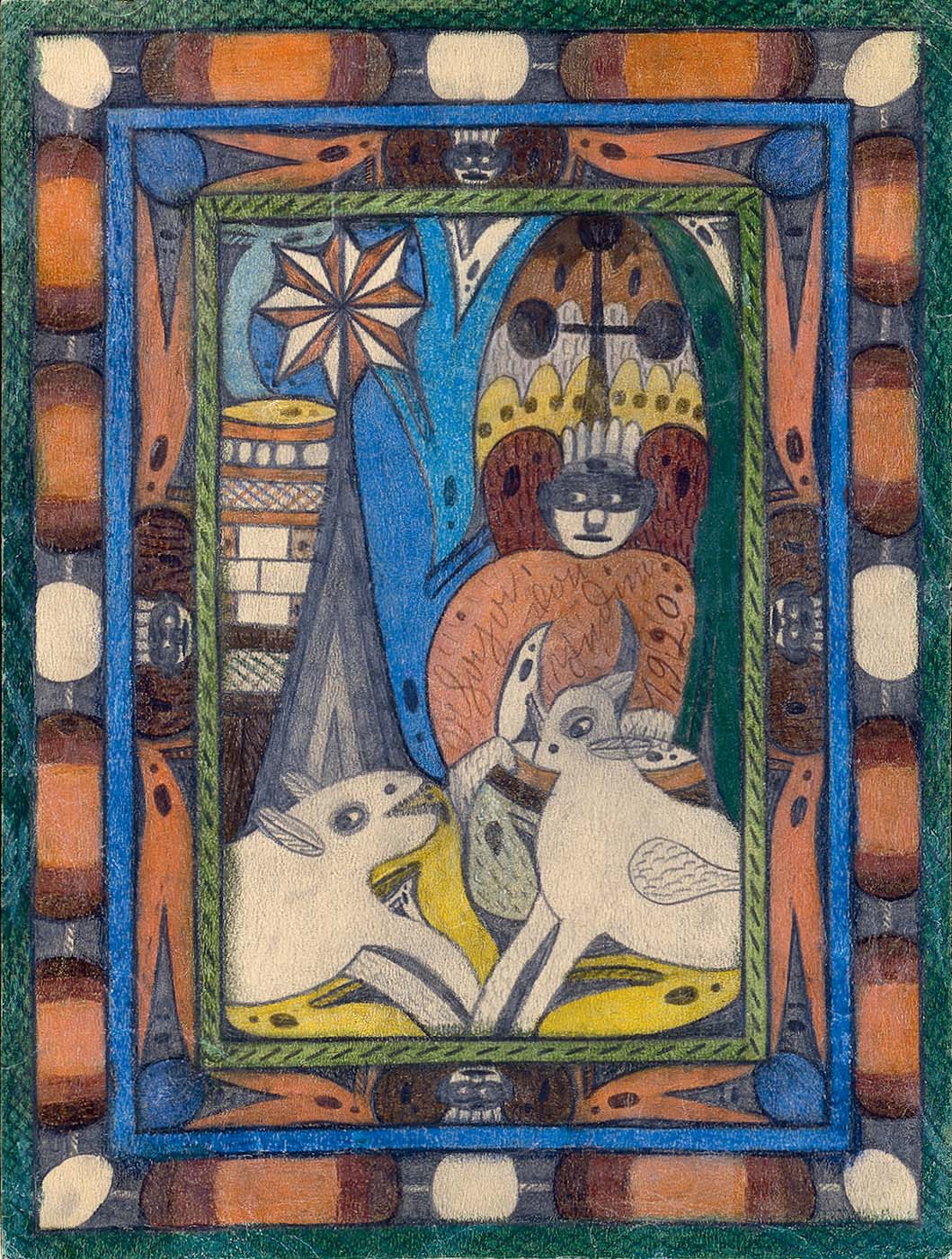
Wölfli’s oeuvre includes hundreds of drawings, musical scores, collages, and writings, forming an imaginary autobiography spanning some 25,000 pages. Reflecting on his childhood, he wrote: “It was after a serious illness at age eight that, from that moment on, I completely and radically forgot EVERYTHING.” From that point onward, he reinvented the world entirely—history, geography, religion, music—seeking to master Creation, Space, and Eternity.
In his writings, Wölfli manipulated language, creating a personal vocabulary and “reforming” words. In his drawings, he combined multiple perspectives to construct intricate networks, where ornamental elements, such as musical staves, served both decorative and rhythmic purposes. He often referred to himself as “Saint” or “Emperor,” recounting a fictitious childhood in dense, colorful narratives. Wölfli’s body of work consists of hundreds of drawings, musical scores, collages and numerous writings forming an extravagant imaginary biography of twenty-five thousand pages. He reinvents everything: history, geography, religion, music, etc. He intends to dominate Creation, Space, but also Eternity. He also excels in pictorial inventions and plays with the superpositions of opposite perspectives: the fusion of several points of view reveals complex networks, where the ornamental elements (staves for example) have a decorative function as well as rhythmic. “Rejected,” victim of a “bitter accident,” Wölfli called himself “Saint,” “Great-Great-God,” “Genius,” or “Adolf II,” “Emperor.” In his world, he escaped all accidents or “attacks by monsters. And if he died, he revives. But he also nicknamed himself “Doufi” — little fellow, lost in a scary world, locked in an endless spiral, lying on his deathbed, in his coffin, the center of a maze. In 1928 he began composing his own Marche funèbre [Funeral March], a requiem of thousands of pages whose composition would be interrupted only by his death.
By country
- Angola
- Argentina
- Austria
- Belgium
- Benin
- Brazil
- Canada
- Chile
- Colombia
- Croatia
- Cuba
- Czech Republic
- Finland
- France
- Germany
- Guatemala
- Haiti
- India
- Iran, Islamic Republic of
- Italy
- Jamaica
- Japan
- Korea, Republic of
- Mexico
- Morocco
- Namibia
- Netherlands
- Papua New Guinea
- Peru
- Philippines
- Poland
- Portugal
- Russian Federation
- Senegal
- Serbia
- Slovakia
- Spain
- Sweden
- Switzerland
- United Kingdom
- United States
- Uruguay
collection | general collection | W | WÖLFLI Adolf
WÖLFLI Adolf
1/5