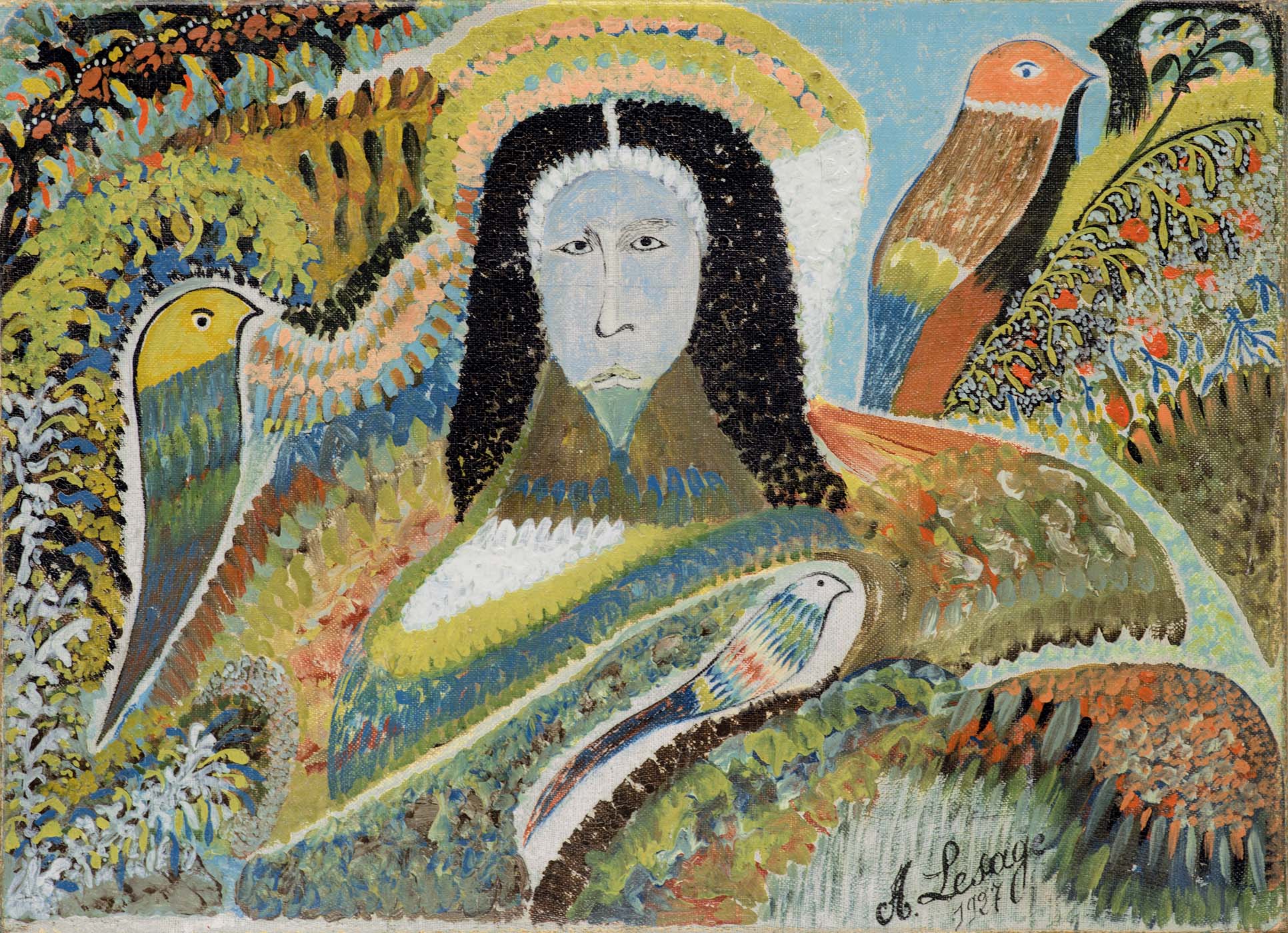
In 1911, while working underground, the miner Augustin Lesage heard a voice announcing to him: “One day, you will be a painter!” He was later initiated into spiritualism by his friend Ambroise Leconte, with whom he founded the Institute of Psychic Forces in Béthune in 1913. That same year, he also declared himself a healer through the laying on of hands, receiving up to one hundred people a day with Leconte — both were prosecuted by the Medical Union for illegal practice of medicine.
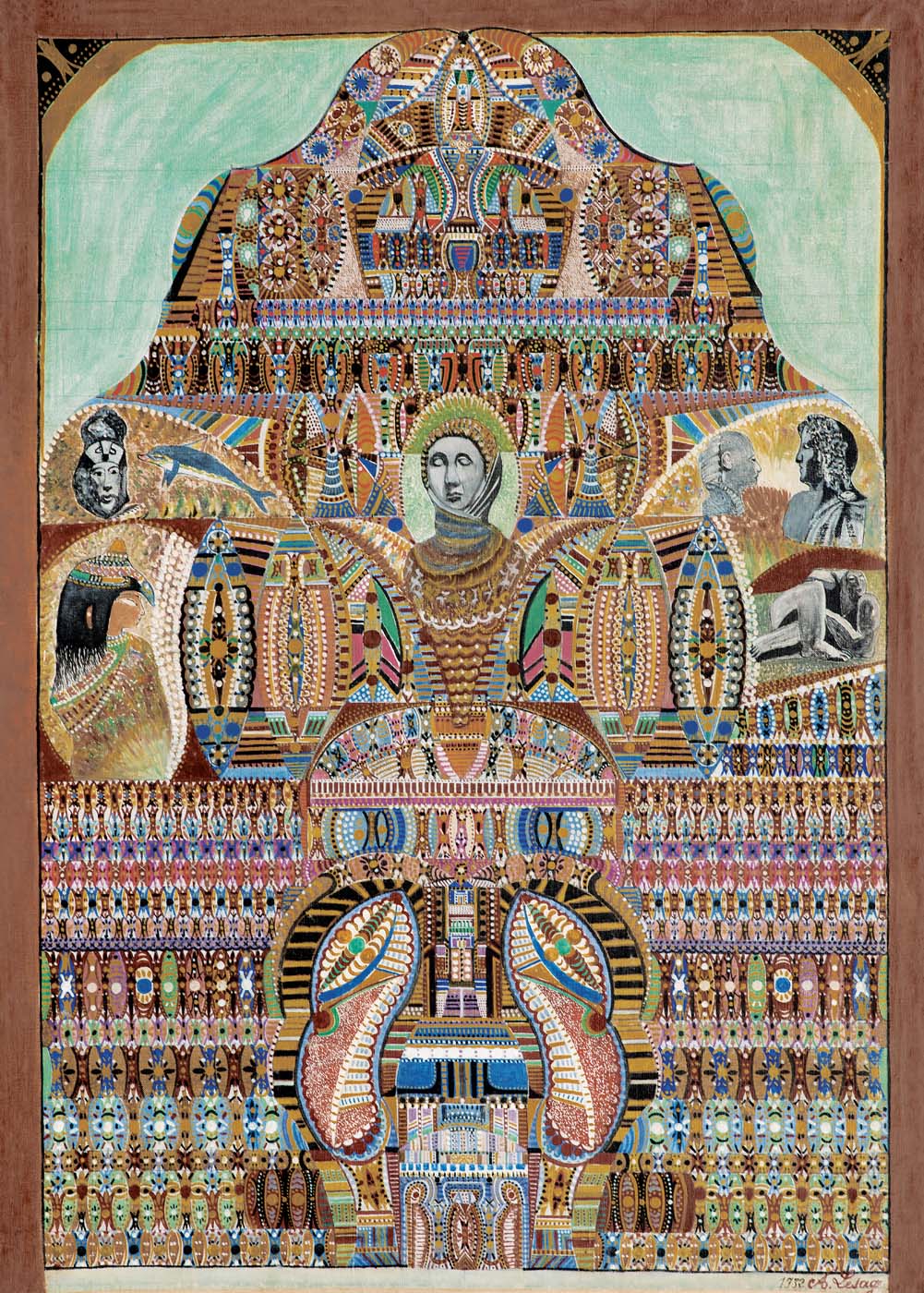
Shortly after his first revelation, Lesage undertook a vast canvas (nine square meters), to which he devoted all his free time for over a year. He claimed his works were dictated by the spirit of Leonardo da Vinci, the Neopythagorean philosopher Apollonius of Tyana, or his younger sister who died at age three, stating: “My guides told me: ‘Do not try to understand what you are doing.’” His meeting with the Egyptologist Alexandre Moret sparked a deep passion for ancient Egypt, and he claimed to be the reincarnation of an artist from the time of the Pharaohs. Lesage only belatedly agreed to sign his works with his own name; he sold his paintings at the cost of materials and a miner’s hourly wage. From 1923 onward, supported financially by Jean Meyer, director of La Revue Spirite, he stopped working in the mines to devote himself entirely to painting. Lesage attracted the interest of the Surrealists, particularly André Breton, as early as 1933.
By country
- Angola
- Argentina
- Austria
- Belgium
- Benin
- Brazil
- Canada
- Chile
- Colombia
- Croatia
- Cuba
- Czech Republic
- Finland
- France
- Germany
- Guatemala
- Haiti
- India
- Iran, Islamic Republic of
- Italy
- Jamaica
- Japan
- Korea, Republic of
- Mexico
- Morocco
- Namibia
- Netherlands
- Papua New Guinea
- Peru
- Philippines
- Poland
- Portugal
- Russian Federation
- Senegal
- Serbia
- Slovakia
- Spain
- Sweden
- Switzerland
- United Kingdom
- United States
- Uruguay
collection | general collection | L | LESAGE Augustin
LESAGE Augustin
1/2