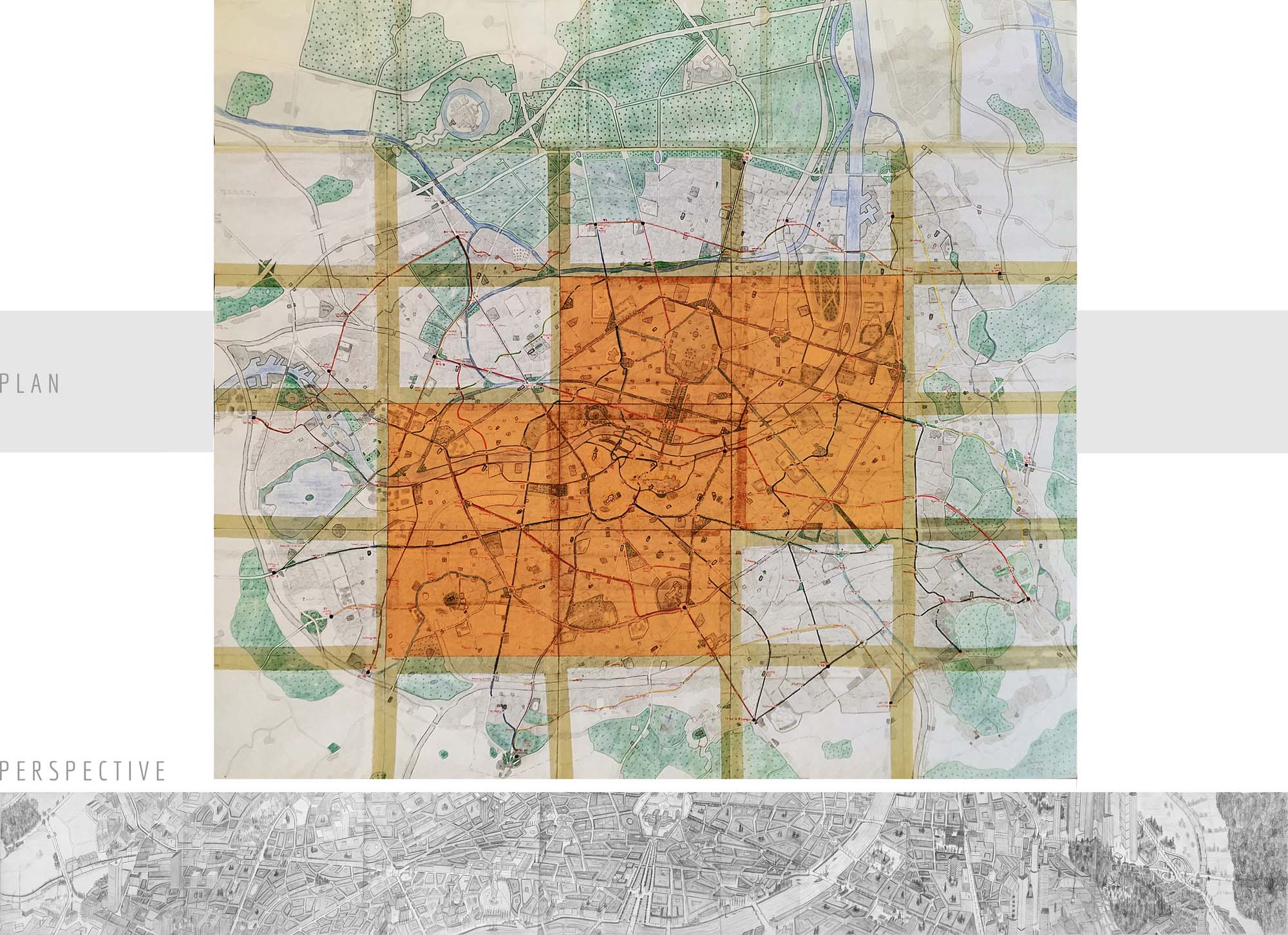
Christophe Barcella grew up in a working-class family with complex multicultural roots, which fostered his interest in exploring his origins and in traveling. Around the age of eight, he endlessly leafed through illustrated Larousse encyclopedias, fascinated by maps of the world and historical figures, playing detective across space and time in the privacy of his room. While his passion for archaeological digs and explorations into his family genealogy satisfied his thirst for investigation, he transposed this quest into plans of imaginary cities, which he drew in great numbers and enriched with architectural elements. He recorded them in notebooks and even went so far as to create large-scale ideal megacities on A4 sheets that he assembled as his cities expanded. This visceral need to “map” gradually evolved into a form of meditation, and with painting, city maps became pictorial relief plans during his adolescence. As an adult, torn between scientific rationalism and artistic exploration, Christophe Barcella chose a career as an international consultant in pharmaceutical research, while never ceasing to create his utopian city plans.
BARCELLA christophe