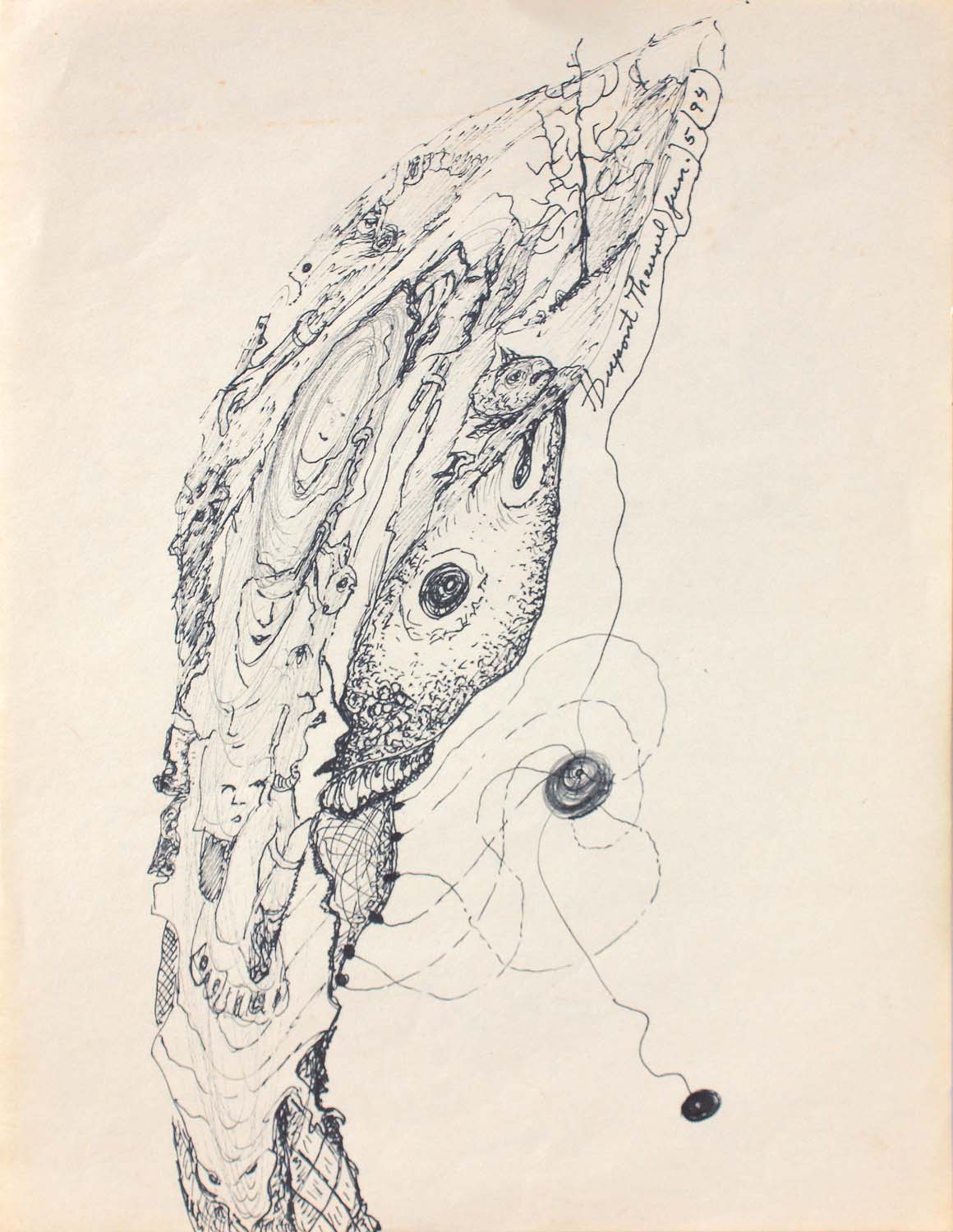
Hilda Dupont-Theurel belongs to the fourth generation of French immigrants born in Mexico. A precocious child, she drew every day: at five years old, standing on a ladder, she decorated the entire height of the back façade of her house with charcoal collected from beneath the wash boilers. But the happiness of her childhood ended with the death of two of her ten siblings.
At eighteen, Hilda Dupont-Theurel was accidentally electrocuted. On the verge of death, she saw herself leaving her body and entering a luminous, warm space where she felt extraordinarily well. During the birth of her first son, she suffered a second cardiac arrest and experienced a similar vision. Since then, she has suffered from depression accompanied by apparitions of faces, which in her village led to her being considered mad. The discovery in 1981 of her husband’s infidelities only worsened her condition. Her psychiatrist encouraged her to continue painting—believing it to be the only way to contain her anxieties.
Color gradually disappeared from Hilda Dupont-Theurel’s work, overtaken by a sense of rage or sadness. Since 2002, perhaps weary of painting only negative emotions, she has sought to express love in her work.
By country
- Angola
- Argentina
- Austria
- Belgium
- Benin
- Brazil
- Canada
- Chile
- Colombia
- Croatia
- Cuba
- Czech Republic
- Finland
- France
- Germany
- Guatemala
- Haiti
- India
- Iran, Islamic Republic of
- Italy
- Jamaica
- Japan
- Korea, Republic of
- Mexico
- Morocco
- Namibia
- Netherlands
- Papua New Guinea
- Peru
- Philippines
- Poland
- Portugal
- Russian Federation
- Senegal
- Serbia
- Slovakia
- Spain
- Sweden
- Switzerland
- United Kingdom
- United States
- Uruguay
collection | general collection | D | DUPONT-THEUREL Hilda
DUPONT-THEUREL Hilda